
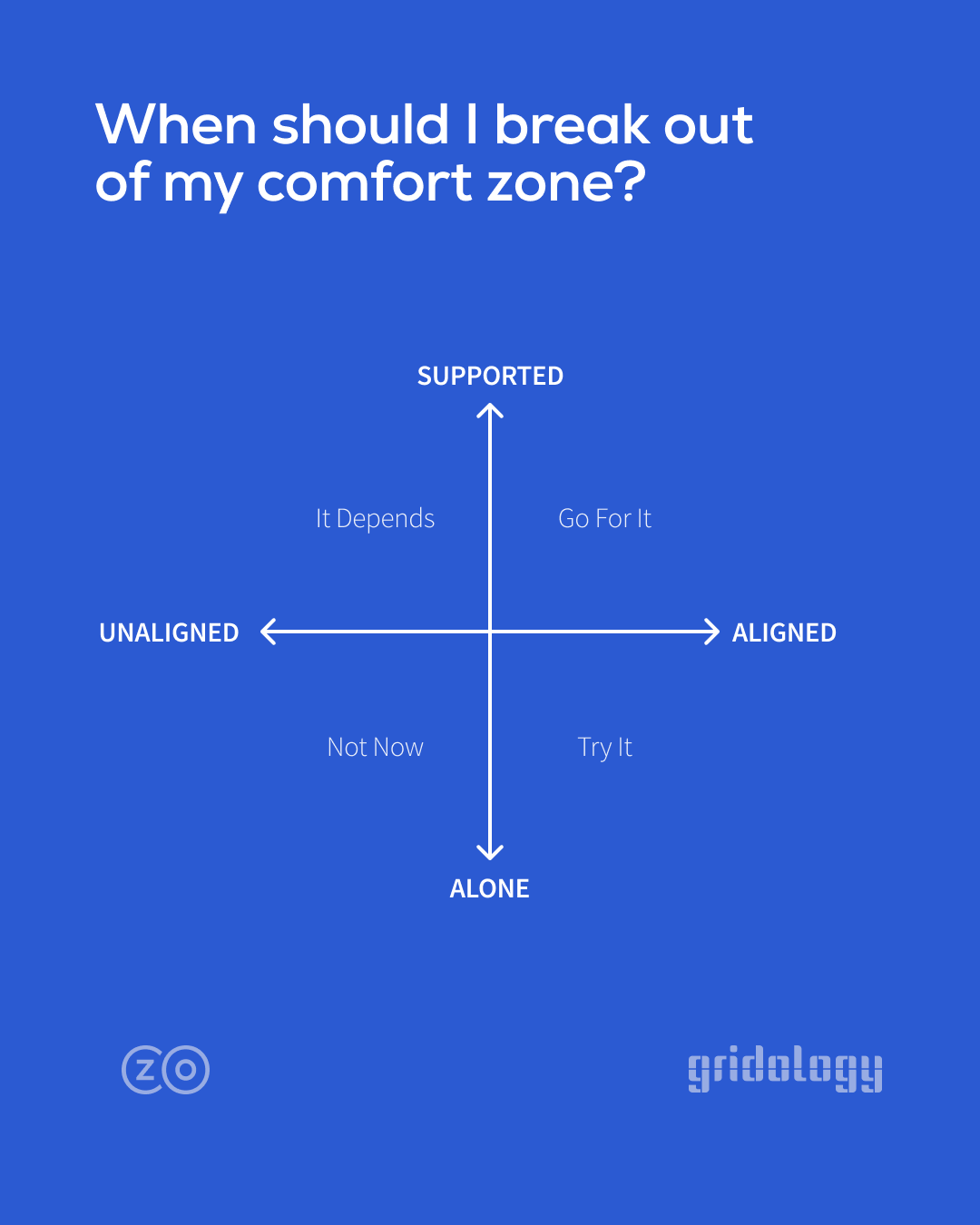
Here’s how to decide when the timing is right.
We teamed up with Ross Gordon, creator of Gridology, to devise a matrix that helps people determine when to break out of one’s comfort zone. It comes down to two major factors: how supported you feel in the activity or experience, and how much this activity or experience aligns to your values. When something aligns to your core values, go for it. Or try it out at the very least. On the other hand, if the activity or experience does not align with your core values, it depends. if you feel supported in it and you have any sort of curiosity, perhaps you try it out and see if it might be more aligned to your values that you think. Or, maybe now isn’t the right time. Either way, understanding your values can be a useful reference point.

We can grow new brain cells. Here’s how.
According to experts at Harvard Medical School, we didn’t think it was possible to grow new brain cells until the mid-1990s, when researchers really began delving into the study of neurogenesis. Neurogenesis is the process of growing new cells and this process continues throughout our lives, even as we get older. Researchers have found that challenging our brains, like learning a new skill, or challenging our bodies physically, can lead to new connections between brain cells, increasing the number of neurotransmitters, and ultimately changing how connections are made.

New experiences make time pass more slowly.
David Eagleman, a professor at Stanford University, and author of The Brain: The Story of You, shares the key ingredient to making our days pass more slowly is to seek out novelty — including new experiences, new activities, and new environments. “When you go and experience something novel, it seems to have lasted longer,” he says, because you’re more focused on collecting the unfamiliar information into a memory. It’s why time seems to fly by so much faster as an adult then it did when you were young: “When you’re a kid, everything is novel and you’re laying down new memories about it. So when you look back at the end of a childhood summer, it seems to have taken a long time because you remember this and that, this new thing, learning that, experiencing that,” Eagleman says. “But when you’re older, you’ve sort of seen all the patterns before.”
Trying new things is connected to positive emotions.
Psychologist Rich Walker from Winstone-Salem State University looked at 30,000 event memories and over 500 diaries and found that people who sought out a variety of experiences throughout their lives were more likely to experience positive emotions. On the other hand, those who had fewer experiences were more likely to experience negative emotions.